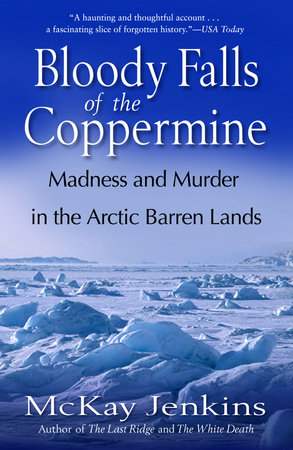

Their fate, and the fate of the people they hoped to teach about God, was about to take a tragic turn. Three days after reaching their destination, the two priests were murdered, their livers removed and eaten. Suddenly, after having survived some ten thousand years with virtually no contact with people outside their remote and forbidding land, the last hunter-gatherers in North America were about to feel the full force of Western justice.
As events unfolded, one of the Arctic’s most tragic stories became one of North America’s strangest and most memorable police investigations and trials. Given the extreme remoteness of the murder site, it took nearly two years for word of the crime to reach civilization. When it did, a remarkable Canadian Mountie named Denny LaNauze led a trio of constables from the Royal Northwest Mounted Police on a three-thousand-mile journey in search of the bodies and the murderers. Simply surviving so long in the Arctic would have given the team a place in history; when they returned to Edmonton with two Eskimos named Sinnisiak and Uluksuk, their work became the stuff of legend.
Newspapers trumpeted the arrival of the Eskimos, touting them as two relics of the Stone Age. During the astonishing trial that followed, the Eskimos were acquitted, despite the seating of an all-white jury. So outraged was the judge that he demanded both a retrial and a change of venue, with himself again presiding. The second time around, predictably, the Eskimos were convicted.
A near perfect parable of late colonialism, as well as a rich exploration of the differences between European Christianity and Eskimo mysticism, Jenkins’s Bloody Falls of the Coppermine possesses the intensity of true crime and the romance of wilderness adventure. Here is a clear-eyed look at what happens when two utterly alien cultures come into violent conflict.
Author
Mckay Jenkins
McKay Jenkins holds degrees from Amherst, Columbia’s Graduate School of Journalism, and Princeton, where he received a PhD in English. A former staff writer for the Atlanta Constitution, he has also written for Outside, Orion, and many other publications. He is the author of What’s Gotten Into Us: Staying Healthy in a Toxic World; Bloody Falls of the Coppermine: Madness, Murder and the Collision of Cultures in the Arctic, 1913 (Random House, 2005); The Last Ridge: The Epic Story of the U.S. Army’s 10th Mountain Division and the Assault on Hitler’s Europe (Random House, 2003); The White Death: Tragedy and Heroism in an Avalanche Zone (Random House, 2000); and The South in Black and White: Race, Sex, and Literature in the 1940s (Univ. of North Carolina Press, 1999). He is also the editor of The Peter Matthiessen Reader (Vintage, 2000). A winner of the University of Delaware’s Excellence in Teaching Award, Jenkins is currently Tilghman Professor of English and a member of the Program in Journalism. He lives in Baltimore with his family.
Learn More about Mckay Jenkins