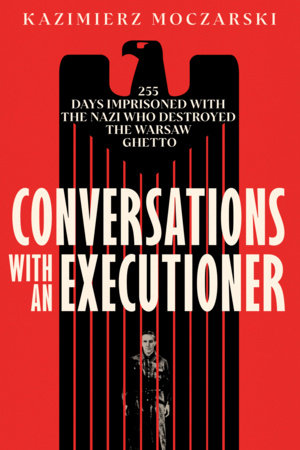
“A Polish classic which evokes the past but also sheds light on the predicaments of the present.” — Anne Applebaum, author of Autocracy, Inc.
“It’s a stark X-ray of a Nazi soul.”
—Publishers Weekly
“This volume hits hard and is a taut, direct, and haunting blend of journalistic precision and visceral storytelling that will grip historians, Holocaust scholars, and general readers.”
—Library Journal, Starred Review
“This fascinating revelation of how a good little middle class boy turns into a Nazi mass murderer is all the more chilling for the forensic, at times witty, style in which his horrified cellmate and near-victim records it. A page-turner and must-read for understanding the workings of the Holocaust.”
—Adam Zamoyski, author of Poland: A History
“An extraordinary book, almost impossible to categorize: simultaneously an act of witness and a work of the imagination, a brilliant portrait of a mediocre man’s rise within the Nazi hierarchy, unsparing and yet deeply human.” — Jane Rogoyska, author of Hotel Exile
“Quite simply one of the most remarkable books to emerge out of World War II. Part unlikely memoir and part biography, it gives an insight into the Nazi mind that is as fascinating as it is chilling. Outstanding.”
—Roger Moorehouse, author of Wolfpack: Inside Hitler’s U-Boat War
“A remarkable document. By turns shocking and chilling but always compelling, Moczarski’s prison conversations with a senior, serial and shameless Nazi killer provide an invaluable insight into the heart of a hideous ideology.”
—Jonathan Dimbleby, author of Endgame 1944
“Essential reading for all those interested in the Nazi occupation of Poland, the mass murder of Polish Jews and the larger history of the Second World War.”
—Antony Polonsky, Emeritus Professor of Holocaust Studies, Brandeis University and Chief Historian, Global Education Outreach Project, Museum of Polish Jews in Warsaw
“A remarkable feat of reportage and timely insight into the Nazi mind.”
—Charlie English, author of The CIA Book Club
“An intriguing document that portrays Stroop as the exemplary perpetrator: a mediocrity promoted above his abilities, but fanatical in his allegiance to Hitler, Himmler and Nazi ideology. Moczarski, working from memory, brings to light the workings of the Nazi mind with penetrating insight.”
—Dan Stone, author of The Holocaust: An Unfinished History
“Extraordinary, original, gripping, and painfully relevant to our times.”
—Philippe Sands, author of East West Street
“A richly textured three-dimensional portrait of a two-dimensional mass murderer who presided over the liquidation of the Warsaw Ghetto, never revealing a hint of a conscience. Although Hannah Arendt did not coin the phrase ‘the banality of evil’ until much later, Jürgen Stroop already embodied it.”
—Andrew Nagorski, author of Hitlerland
“A fascinating and totally unexpected account of one of the darkest periods of the Second World War.”
—Antony Beevor, author of Stalingrad






 QUICK VIEW