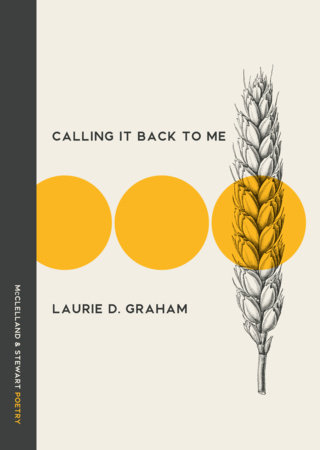
“‘I miss the lives / I have not lived,’ writes Laurie Graham and an unrelenting, tender, brave historical introspection begins. She looks especially for the four great-grandmothers, those homestead lives, and is struck repeatedly by their unknowability which over time has become what she is, the same gait, same brow, same don’t-cross-me streak. The trail to the dead is snow-packed and often disappears entirely. This is a moving book of desire, identity, homage and remorse.”
—Tim Lilburn, author of The Names
“Calling It Back to Me announces a call-and-response suite of poems: the call from ‘erased’ names to those that are ‘retained,’ the call from an ancestral genealogy to the stuttering syllables at a grandfather’s grave, the call from a poet’s singular voice to all the others it is her burden to carry. Graham has called out especially to the great-grandmothers. Sluicing their silences into these poems—‘the women reach out to me now’—she gives them a birthplace, a maiden name, a date of arrival on the Canadian shore, sometimes a place of burial. . . . In the epic sequence, ‘Toward an Origin Story,’ Graham comes to grips with the settler’s paradox: a ‘homeplace’ she never knew, but instead a homestead—‘every arable, pilfered inch’—on ceded Indigenous Territory. The poem asks, What is origin, original? What is mine, not mine? now that the great-grandchildren have fled the dried-up sloughs, ‘the soil long spent,’ for the cities. The great-grandmothers’ silence has been ‘clenched,’ ‘persistent,’ as though, left unuttered, their words hint only at their potential. Then Graham opens the letter box and out fly their cries, ‘to the whole wide / open world.’”
—Myrna Kostash, author of Ghosts in a Photograph
“In Calling It Back to Me, Laurie D. Graham composes a resonant genealogy ‘suspicious of narrative’; a genealogy of ‘vanished / names’; of ‘churned grasses’ and ‘low poplars yellowing’; of ‘vernaculars that died.’ Her strikingly clear and deeply moving poems reveal a pose of brave and persistent witness that might engender in readers a deeper understanding of their own homeplaces.”
—Sheri Benning, author of Field Requiem