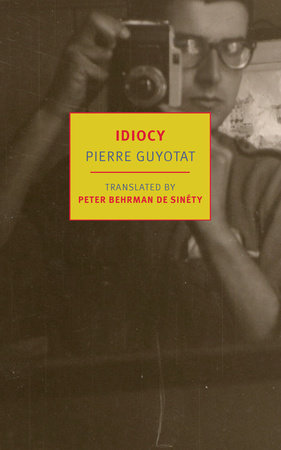
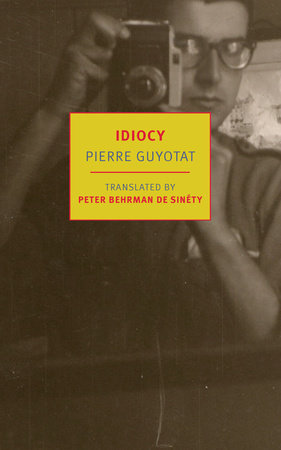
“Pierre Guyotat is the prince of prose.” —Alain Badiou
“Guyotat renders the obscene violence of colonialism with unflinching honesty. His writing is gorgeous, brutally poetic without pretense or over-aestheticization. ‘Insects scuttle between my fingers like words that escape me.’ I didn’t just read Idiocy, I was captured by it. It is a book that throws off your blinders, that changes you.” —Dodie Bellamy
“Idiocy, as a work of memoir, maintains an uncanny sobriety throughout its reportage, indulgent in its poetical description . . . As a medium intended to survey war and warmongering, Idiocy becomes more than a simple pulling back of the curtain of atrocity; it would, instead, pull down the whole damned rigging, lights, cameras, and all.” —Blake Butler
“What draws readers to Guyotat and the other writers of the transgressive tradition is that they are candid about violence. Violence may not be the totality of life, but it is closer to the core of it than spurious humanisms would have us believe.” —Ryan Ruby, The Baffler
“[Guyotat] is a latter-day heretic in a tradition that runs from the Marquis [de Sade]’s cold despotism and Goya’s late thrashings, through Lautréamont and Baudelairean Spleen, to Jean Genet, Pier Paolo Pasolini, and Kathy Acker . . . [Idiocy] is Guyotat’s most explicitly political work: his last book before his death and an account of that dark fulcrum of his life and career, his military service in Algeria . . . Idiocy’s extraordinary vim derives from the myriad binaries that embroil it: art and life, biography and history, desire and sex, human and animal, witness and victim, any of whose resolutions would stifle it.” —R.K. Hegelman, The Nation
“[Guyotat is] anti-authoritarian, pushing the French language to its limits of meaning, and fascinated by the filth of fighting, illness, and recovery. . . An ugly, terrifying memoir of childhood, war, and violation, rendered into nightmarish English.” —Kirkus Reviews






 QUICK VIEW