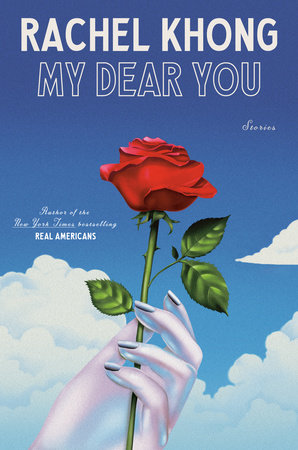
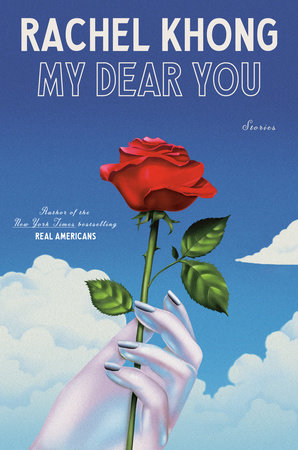
1. You’ve written two acclaimed novels, Goodbye, Vitamin (2017) and Real Americans (2024). MY DEAR YOU is your debut collection of short stories, which you wrote over the past decade while also writing your novels. What do you think the shorter form of fiction offers that novels don’t?
Where writing a novel is a way to have a conversation with myself over a period of years, a story feels more like a song. Stories I’ve enjoyed, as a reader, capture a question or mood, provide pleasure, leave me feeling changed, whether slightly or seismically. The novel is a very capacious form and can contain a lot. I prefer a novel that feels as though it’s bursting with life—as if the writer had too much to say. In spite of its capaciousness, novels have themes, primary concerns, and specific architecture. A lot can fit into a novel, but not everything. For me, that’s where stories come in. Stories contain what novels can’t fit. But the opposite is also true: Writing a story often tells me what I’m interested in, before my conscious self quite understands what I’m interested in. It may seem odd for these two very different works to share a lineage, but “My Dear You,” written in 2016, was one of the seeds that led me to write Real Americans, which is interested in what makes us who we are: the choices we make and choices that are already made for us.
Writing a novel takes me a long time (historically, it’s taken me approximately five to seven years). The process is interesting and meaningful, yes, but also difficult and frustrating; writing a novel always tests my patience. Stories have their own challenges, but in a shorter form, those challenges are much more manageable. I write them to remind myself that I can still finish things. They renew my trust in my own writing, and reassure me that I can finish what I start.
2. You write about the collection, “If there’s a unifying theme, it’s the mid-life realization that life is limited and finite: that we don’t get to lead all possible lives, or go down all possible paths. It’s about mourning that sense of possibility, but also about finding beauty in our limits.” Can you elaborate on this?
Growing up in America, I was raised with a sense of invincibility. I was asked what I wanted to be when I grew up; I was under the impression that I could do anything, and be anyone. It’s a feeling that persisted into my twenties, this sense of infinite possibility. When I entered my mid-thirties, during the pandemic, it occurred to me that this wasn’t true at all. We had been lied to! Life was not infinite, but limited. Certain decisions I’d made—where I lived, who I’d married, what I did for a living—foreclosed on other possibilities. The culture we live in does not encourage us to accept these limits; the internet, especially, exacerbates this. Tech bros promise that we can live longer (maybe even forever?) with just the right products; influencers give the impression that we can have it all—beauty, wealth, vacations, some ideal family. I wrote many of these stories as a way of working through the limits I realized I was up against: the limits of life itself. I realized that limits wanted to teach me something once I stopped struggling against them. Mortality itself is a limit that gives life itself meaning.
At the same time, I write to come up against my own limits. I’ve always resonated with Susan Sontag saying, “What I really wanted was every kind of life, and the writer’s life seemed the most inclusive.” Writing is a way of multiplying my own life—getting to try on other lives for size.
3. Insidious racism surfaces many times throughout MY DEAR YOU—doctors assuming an Asian patient is lactose intolerant; a man with an extremely problematic Asian fetish; even a racist dog in heaven. You approach these moments in a way that feels honest, lived-in, and even humorous, rather than didactic. Can you talk about this?
These stories were written through strange and difficult years: the Trump presidency, the Covid-19 pandemic, the many, many murders of Black men at the hands of police, the MeToo movement… to name just a few. These are topics addressed in the stories, both directly and indirectly. Though several of the stories are explicitly about race, I was interested in writing the more casual racism that I encountered in my own life as an Asian American woman. (Which isn’t to say that Asian American women don’t overtly experience racism; we do.) But I was more interested in documenting the quieter, gently insidious, often funny sort. In 2017, the writer Leonard Chang shared a rejection letter he’d received from an editor: “The characters, especially the main character, just do not seem Asian enough. They act like everyone else. They don’t eat Korean food, they don’t speak Korean, and you have to think about ways to make these characters more ‘ethnic,’ more different. We get too much of the minutiae of [the characters’] lives and none of the details that separate Koreans and Korean-Americans from the rest of us. For example, in the scene when she looks into the mirror, you don’t show how she sees her slanted eyes, or how she thinks of her Asianness.” It was important to me to write about Asianness in a way that felt true to my lived experience. In My Dear You, Asian characters “act like everyone else,” until, often, some racist action reminds them of how they are perceived by others.
4. Many of these stories engage with mortality, solitude, and the spiritual or supernatural—hantu, hauntings, the sense of being watched by alternate selves. What draws you to these themes? What do you hope readers will take away from them?
I grew up in a very religious Christian household, but as an adult, my own beliefs lean more mystical. (The box I checked on my medical intake form was “Spiritual but not religious.”) I didn’t think that my stories were particularly interested in the religious or the spiritual, until I put them all together for this collection and saw that there was a story about heaven, a story in which God decides that humanity should come to an end (like Noah and the flood), and stories about the spiritual and supernatural. One reason I left the organized religion of my childhood is that it struck me as more oriented in certainty than in mystery. But an interest in the unknown and the mysterious—which is at the core of what many religions and spiritual traditions concern—persists in me. As a writer, uncertainty strikes me as the more generative and interesting mindset. I’m not sure what’s “real” and what’s not. I’m not certain it even particularly matters.
5. “Tapetum Lucidum” is a beautiful story about the ghosts of what might have been, and how the specters of all our possible selves can haunt—and taunt!—us. What inspired that story, and how do you think about haunting more broadly in your fiction?
My cat, Bunny, was the muse for “Tapetum Lucidum.” In 2018, my husband and I visited the San Francisco SPCA “just to see” and left with a tiny tortoiseshell kitten in a box. Immediately, she was family. She was charming, but also mysterious and often erratic: it seemed as though she saw things that we couldn’t. At night, her eyes seemed to glow in the dark. Was she aware of entities we weren’t attuned to? I wondered. And the story grew from there.
At the time of writing the story, I had been recently married. I was thinking of the way that the person you marry shapes your life in both minor and major ways (as a minor example, I watch very little reality television because my husband dislikes it). Our lives are limited: living one particular life means you can’t live another. It’s something I’ve long thought about as an immigrant to this country: living here in the U.S. means that I no longer live in Malaysia, where I was born. The person I would have been, had I been raised there, is someone else entirely. I don’t know if ghosts exist, but alternative pasts certainly do. There’s no precise word to describe the grief of not getting to live a different reality, but “haunting” strikes me as coming very close.
6. Your stories often explores strange alternate realities. Do you think these realities reveal something essential or true about our own?
It’s a very human tendency to ask “What if?” My imagination has always been drawn to alternate possibilities, and many of these stories came from “What if?” questions. The oldest of these stories were written during the first Trump presidency. There was always the question in the back of my mind: What if this hadn’t happened? What if this particular president had not been elected? What would the world look like? How would things be different?
Realistic stories mirror the world as it is, but strange or alternate worlds let me distort the familiar, or exaggerate an element so that we can see the world differently. Alternate realities can ask, What if this was different? What would that reveal about us?
7. There’s a line in the story “Colors from Elsewhere” about how everyone’s grief is specific to them, but still part of “the same fraying ribbon” of a collective experience. (I won’t even say “human experience” because not all of these characters are human.) How do your stories find those emotional through-lines across difference?
The literature—and art more broadly—that has moved me most has been specific and particular to the experience of the writer or artist. Though the art in question may be about experiences I haven’t personally had, I’m in possession of my own imagination and my own empathy. When an artistic work is rich with attention and specificity, I can meet it with experience, attention, and specificity of my own. As a writer, I’m responsible for writing that engages the reader’s imagination. But it’s also the reader’s responsibility to meet the story with their own imagination, and their own experience. My hope is that readers will meet me there. What interests me is not pretending we’re all the same, but exploring how very different beings can still experience parallel forms of grief, fear, joy, shame. It’s not sameness, but resonance.
8. In these stories, love is often complicated—whether it’s romantic, filial, or haunted by loss—but always rendered with clarity. Do you consciously write against sentimentality?
I strive to write in such a way that is unafraid of feeling. There has long been a double standard in literature: male authors are given critical acclaim for writing emotion, but when women write emotion, it’s at risk of being called “sentimental.” I’m not interested in sentimentality, which I define as unearned emotion. But I write from feeling and toward feeling because it’s a challenge, and I am interested in that challenge. To write feeling is difficult; to do it in a way that reflects the complexity of real life is even more difficult.
Sentimentality flattens emotion into something predictable. But real love, like real people, always carries some kind of shadow. I try to let those shadows stay in the frame.
9. Vauhini Vara wrote about MY DEAR YOU, “You start out laughing, then realize you’re crying.” How do you think about humor’s relationship to sorrow in your work?
Humor and grief seem to me so intertwined. Humor and rage, too. (Racism often is very funny.) Emotions are never clear cut—at least, they aren’t for me. During moments of deep grief, I’ve also found myself laughing, or cracking jokes as a way of coping. We are an easily distractible species, and it’s difficult to remain in one emotion at any given time. “Colors from Elsewhere” is a story that I wrote after I had my first miscarriage. I recently had a second miscarriage, and soft music was playing in the operating room, where I was waiting, in my hospital gown, for a D&C to remove the “products of conception.” A song came on: “Your Body is a Wonderland.” I had been on the verge of tears, but I had to laugh.
10. There’s a moment in the story “D Day” when a character reflects, “Humans were more at ease with human-size problems. Being struck with awe, remembering how small one was, how little one knew, the fact of one’s mortality and insignificance and triviality—it was all deeply uncomfortable.” For all that these characters admit to not knowing, the stories they inhabit seem uniquely wise. Does fiction help you—or your characters—confront this discomfort?
Writing fiction is one of the best ways I know how to practice discomfort, and to practice not knowing. To practice playfulness and fearlessness, and to meet the unknown with curiosity. It’s practice that I need as a mortal being—a reminder that I am not in control, that both writing and life are fundamentally mysterious. Things happen that we do not prefer; life can be really hard sometimes. Fiction is one of the few places where I can embrace discomfort—and learn to trust not knowing as part of the process.






 QUICK VIEW