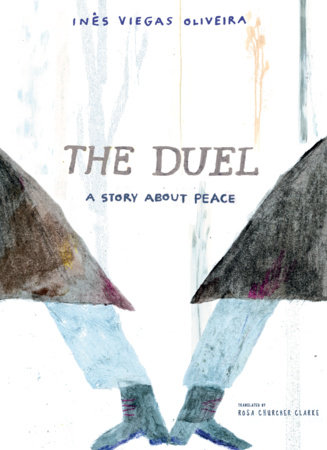
“”When two friends at odds in a wintry place stand back to back and embark on their paces, one keeps walking, into the warm colorful, collegial spring of Oliveira’s dazzling picture book debut.” —The New York Times Book Review
“It’s a picture book, but in a way it could also be for us, or even for our world leaders who . . . don’t seem to know how to pursue peace.” —Deepa Fernandes, “Here & Now,” from an interview with the author
“The Duel is a poignant tale about a duel that never takes place. The main character marches through watercolor illustrations that gradually materialize into bustling city scenes which subsequently transform into peaceful countryside landscapes. Eventually, he settles alone in a sunny meadow where white birds fly across a hopeful blue sky.” —PEN America, from and interview with the author
“This Portuguese import contemplates war and peace by upending a planned duel.
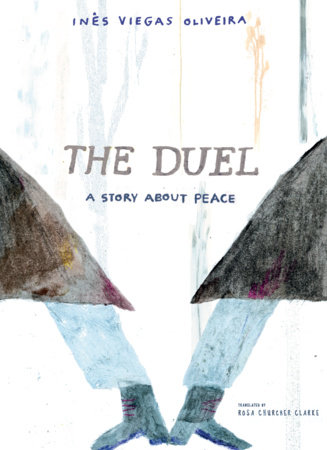
Two men decide to settle their disagreements by dueling. In a barren landscape, each begins the 100-pace walk away from the other, weapon in hand. Yet one, who narrates, simply walks on. He ambles through increasingly vibrant vistas in a pulsing city, witnessing a parade, a circus, and a puppet show. Skin tones, where discernible in the tiny figures, appear pale. With each page turn, the errant duelist encounters fewer people and more animals. In increasingly bucolic scenes, he trades his pistol for a walking stick. Narration—its meaning at times elusive—takes the form of a letter written to his dueling partner, the “Esteemed Mr Rodin Rostov.” Oliveira’s Klee-esque illustrations are stunning. Monochromatic early scenes metamorphose in successive palette shifts: saturated primary colors accented by neutrals for the cityscapes, then greens and ochers as the narrator treks through a village and a pasture. When he ponders his fate, constellations frame images of animals in an ink-blue sky. Over land and water, in fair weather and rain, he finally descends a mountain into a lush, flower-filled meadow. There, he pens his missive, posting it in his top hat. His note implores his friend to “put down your weapons and come on over / to see me, would you?” A migrating white bird takes up the envelope, even as the narrator himself seemingly metamorphoses, achieving unity with nature. Subtly beautiful, with a message of peace. (Picture book. 4-7)” —Kirkus
“In this curious and memorable translated picture book (imported from Portugal), peace is explored through the narration of one duelist who, rather than turning to shoot, just keeps walking. The first image, small and black and white, is striking: two men, back to back, are so close together that they appear to be one figure, before they take their first step apart. As the unnamed narrator walks rightward, he then begins an internal monologue to the other duelist, Mr. Rostov. His contemplation quickly turns from the insults that sparked the challenge and on to philosophical musings about empathy, forgiveness, and the courage required to upend expectations and just choose peace in a world that rarely does. The use of color is spectacular as the man continues walking away, with stark grays replaced by vivid, saturated watercolor- like textures. The joy builds in the increasingly detailed images as page turns reveal a bright city, a tranquil countryside, and finally a mountain, where the man sits alone, surrounded by jewel-tone flowers, sending an invitation out into the world (via a letter carried away by a bird) for the other duelist to set down his gun, turn around, and choose a dramatically different future. There is significant subtlety in the illustrations and text, with vibes sometimes replacing clarity, but that is a comfortable space. Readers are unlikely to be stopped by any single (sometimes opaque) phrase, as the perpetual march to the right encourages steady progress through the book until the end, when the man stops at the edge of a panel, intentionally faces left, and waits patiently as he hopes to see Rostov. This book will resonate long after the final page—a glowing spark of peace in an increasingly dark world.” – The Bulletin of the Center for Children’s Books (University of Illinois, Urbana-Champaign)





 QUICK VIEW