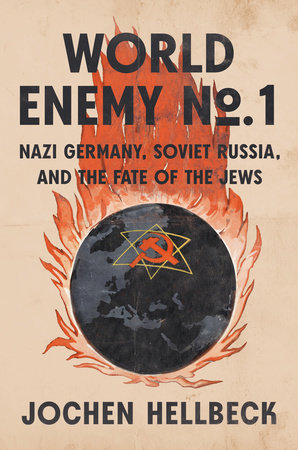
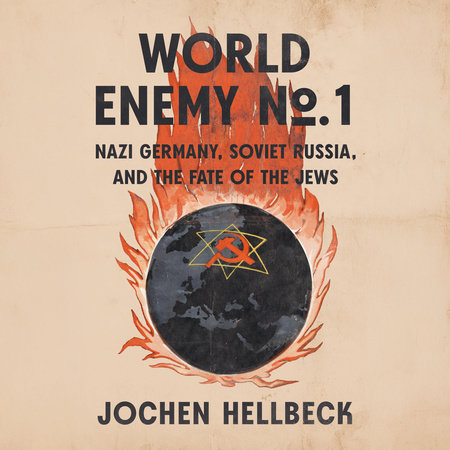
“World Enemy No. 1 is a bracing, necessary corrective, challenging us to look beyond Allied triumphs in the latter stages of the war and the Cold War politics that downplayed the Soviet Union’s role in defeating Nazism. It shifts our gaze instead to the battle grounds and killing fields of the western Soviet Union, where the events of eighty years ago continue to menace Europe.” —Jewish Book Council
“A history of World War II closely focused on its true epicenter: the Russian front . . . An essential contribution to the modern literature of what Russians still call the Great Patriotic War.” —Kirkus (starred review)
“The Nazi crusade against ‘Judeo-Bolshevism’ was directed against Bolsheviks, as well as Jews, and it was the Soviets, Jews among them, who did the most to defeat Nazism. It takes courage, as well as tremendous talent and dedication, to tell this story with so much empathy, eloquence, and insight. World Enemy No. 1 is a magnificent memorial to both the victims and the victors.” —Yuri Slezkine, author of The Jewish Century and The House of Government: A Saga of the Russian Revolution
“In World Enemy No. 1, Jochen Hellbeck, a pioneering historian of Stalinism, has turned his attention to the German-Soviet genesis of the Holocaust. The book breaks new ground by shifting the focus from some primordial German hatred of Jews to the fierce political competition between Hitler’s fascism and Soviet Communism, which Hitler re-coded as ‘Jewish Bolshevism.’ Hellbeck reminds us of the original wording of Martin Niemöller’s warning, ‘first they came for the Communists’—for the people they deemed most threatening to their political project—and then they came for everybody else.” —Keith Gessen, author of A Terrible Country
“In this passionate, original history, Jochen Hellbeck explores how Adolf Hitler fused his twin obsessions against Jews and Communists into a global battle to the death. A vivid, sometimes terrifying account of the Nazi crusade on the Eastern front—a war like no other.” —Victoria de Grazia, historian, Columbia University
“Essential reading. Jochen Hellbeck brilliantly demonstrates how German brutality, recorded and retold by Soviet journalists and historians in the field, shattered Soviet citizens, enraged them, and mobilized them to fight back with bitter intensity. Hellbeck masterfully explains what made World War II on the Eastern front so destructive and why this matters today. A tour de force of historical writing.” —Paul Hanebrink, author of A Specter Haunting Europe
“Historical amnesia is a treacherous condition: it betrays memory and distorts the future. In a time in which anti-Communism is being resurrected as a cudgel against liberal values, Jochen Hellbeck courageously sets out to restore the Soviet role in the defeat of Nazism. Soviet suffering, the colossal loss of more than 26 million Soviet citizens in their four-year war against Hitler, has been largely erased from public memory. Without excusing the pathologies and atrocities of the Stalinist system, Hellbeck unfolds the tragic tale of how a despotic regime saved the democratic world.” —Ron Suny, author of Stalin: Passage to Revolution







 QUICK VIEW