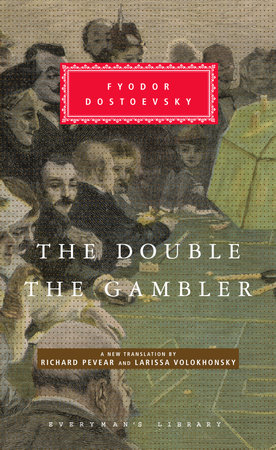



“Pevear and Volokhonsky may be the premier Russian-to-English translators of the era.”—The New Yorker
The Double is a surprisingly modern hallucinatory nightmare—foreshadowing Kafka and Sartre—in which a minor official named Goliadkin becomes aware of a mysterious doppelganger, a man who has his name and his face and who gradually and relentlessly begins to displace him with his friends and colleagues. In the dilemma of this increasingly paranoid hero, Dostoevsky makes vividly concrete the inner disintegration of consciousness that would become a major theme of his work.
The Gambler is a stunning psychological portrait of a young man’s exhilarating and destructive addiction to gambling, a compulsion that Dostoevsky—who once gambled away his young wife’s wedding ring—knew intimately from his own experience. In chronicling the disastrous love affairs and gambling adventures of Alexei Ivanovich, Dostoevsky explores the irresistible temptation to look into the abyss of ultimate risk that he believed was an essential part of the Russian national character.
Chillingly psychological with timeless portrayals of obsession and destruction, these stunning translations offer a glimpse into the mind of one of the nineteenth century’s most acclaimed writers.
Author
Fyodor Dostoevsky
Fyodor Mikailovich Dostoevsky’s life was as dark and dramatic as the great novels he wrote. He was born in Moscow in 1821. A short first novel, Poor Folk (1846), brought him instant success, but his writing career was cut short by his arrest for alleged subversion against Tsar Nicholas I in 1849. His prison experiences coupled with his conversion to a profoundly religious philosophy formed the basis for his great novels. But it was his fortuitous marriage to Anna Snitkina, following a period of utter destitution brought about by his compulsive gambling, that gave Dostoevsky the emotional stability to complete Crime and Punishment (1866), The Idiot (1868–1869), The Possessed (1871–1872), and The Brothers Karamazov (1879–1880). When Dostoevsky died in 1881, he left a legacy of masterworks that influenced the great thinkers and writers of the Western world and immortalized him as a giant among writers of world literature.
Learn More about Fyodor Dostoevsky