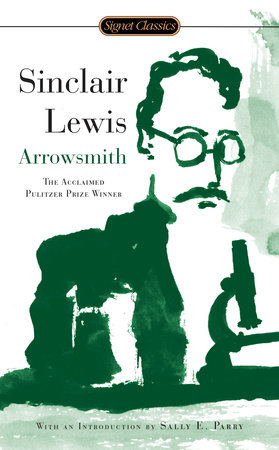
Sinclair Lewis (1885-1951) won the Nobel Prize for literature in 1930, the first American novelist to be so honored. He was born in Sauk Centre, Minnesota, the son of a doctor. After an extremely unhappy childhood, he went to Yale but left before graduation to work in Upton Sinclair’s socialist colony at Helicon Hall in Englewood, New Jersey. Unable to make a living as a freelance writer, he returned to Yale and graduated in 1908. In 1914 he published his first novel, Our Mr. Wrenn: The Romantic Adventures of a Gentle Man. But it was not until his sixth novel, Main Street (1920), that he won recognition as an important American novelist, the first to challenge the myth of the happy quintessentially American small town. His major works are Babbitt (1922), Arrowsmith (1925), which won a Pulitzer Prize that Lewis refused to accept, Elmer Gantry (1927), Dodsworth (1929), and It Can’t Happen Here (1935), which he also wrote as a play in 1936. Married and divorced twice, the second time to pioneering newspaperwoman Dorothy Thompson, Lewis was a prolific writer, publishing dozens of books and innumerable articles throughout his career. He died alone in Rome on January 10, 1951, and his ashes were returned to Sauk Centre, the “Main Street” he’d rejected so many decades before but which in death took him back as its own.
Learn More about Sinclair Lewis







 QUICK VIEW