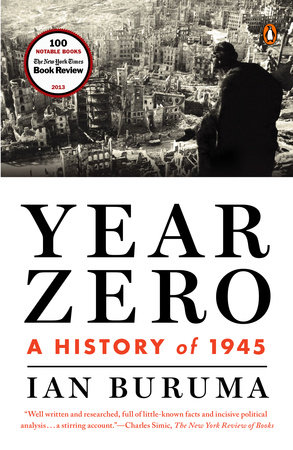
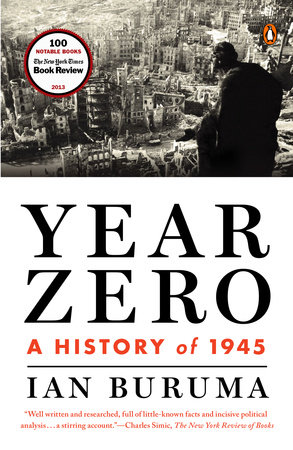
“Year Zero . . . covers a great deal of history without minimizing the complexity of the events and the issues. It is well written and researched, full of little-known facts and incisive political analysis. What makes it unique among hundreds of other works written about this period is that it gives an overview of the effects of the war and liberation, not only in Europe, but also in Asia . . . A stirring account of the year in which the world woke up to the horror of what had just occurred and—while some new horrors were being committed—began to reflect on how to make sure that it never happens again.” —Charles Simic, The New York Review of Books
“Ian Buruma’s lively new history, Year Zero, is about the various ways in which the aftermath of the Good War turned out badly for many people, and splendidly for some who didn’t deserve it. It is enriched by his knowledge of six languages, a sense of personal connection to the era (his Dutch father was a forced laborer in Berlin) and his understanding of this period from a book he wrote two decades ago that is still worth reading, The Wages of Guilt: Memories of War in Germany and Japan.” —Adam Hochschild, The New York Times Book Review
“[Buruma is] one of those rare historian-humanists who bridge East and West . . . Year Zero has a down-to-earth grandeur. Through an array of brief, evocative human portraits and poignant descriptions of events around the globe he hints, rather than going into numbing detail or philosophical discourse, at the dimensions of suffering, the depth of moral confusion and in the end the nascent hope that 1945 entailed . . . Year Zero is a remarkable book, not because it breaks new ground, but in its combination of magnificence and modesty.” —Wall Street Journal
“[Buruma] displays a fine grasp of the war’s scope and aftermath. Little conventional wisdom survives Mr. Buruma’s astringent prose. Perhaps his most important insight is that the war was not a neat conflict between two sides. The victors included villains, and the vanquished were not all Nazis. On many fronts—notably Yugoslavia—many sides were at war . . . Many of the consequences of victory were grim. Normality returned in the decades that followed thanks to the grit and determination of those who pushed on past the horrors of 1945. Mr. Buruma’s book honours their efforts.” —The Economist
“Elegant and humane . . . As generations with few memories of the second world war come of age in Europe and Asia, this luminous book will remind them of the importance of what Buruma terms ‘mental surgeons’, the politicians and warriors who reconstructed two continents left in rubble.” —Financial Times
“[A] very human history of ‘postwar 1945.’” —The New Yorker
“[Buruma] makes a compelling case that many of the modern triumphs and traumas yet to come took root in this fateful year of retribution, revenge, suffering and healing.” —Smithsonian Magazine
“After total war with millions dead and the Shoah comes what? That is the question that propels critic and historian Ian Buruma’s panoramic history of 1945. It is a personal story for Buruma, inspired by his own father’s experience of the war and its aftermath, but with Buruma’s sharp and careful eye it becomes a window into understanding all the years since then.” —The Daily Beast
“I’ve spent countless hours reading about trenches, tank battles, and dogfights, but no book had yet captured what came after all that as superbly as Ian Buruma does in Year Zero: A History of 1945. This book will change the way you think about the postwar era, i.e. ours.” —Lucas Wittmann, The Daily Beast
“Rooted in first-person accounts—most notably, the author’s own father, a Dutch student forced into labor by the Nazis—Buruma’s compelling book manages to be simultaneously global in its scope and utterly human in its concerns.” —Publishers Weekly (starred review)
“[An] insightful meditation on the world’s emergence from the wreckage of World War II. Buruma offers a vivid portrayal of the first steps toward normalcy in human affairs amid the ruins of Europe and Asia . . . Authoritative, illuminating.” —Kirkus
“In 1945, the war ended, but a new world began. Taken and destroyed cities were transformed; the liberated celebrated; scores were settled; people starved; justice was and was not meted out; soldiers and refugees came home; suffering ended, or continued, or began anew. An eclectic scholar who has written on religion, democracy, and war, Buruma presents a panoramic view of a global transformation and emphasizes common themes: exultation, hunger, revenge, homecoming, renewed confidence. Though there was great cause for pessimism, many of the institutions established in the immediate postwar period—the United Nations, the modern European welfare state, the international criminal-justice system—reflected profound optimism that remains unmatched. Buruma’s facility with Asian history lends this selection a particularly internationalized perspective. But it is the story of his father—a Dutch man who returned home in 1945 after being forced into factory labor by the Nazis—that sews the various pieces together and provides a moving personal touch.” —Booklist
“A brilliant recreation of that decisive year of victory and defeat, chaos and humiliation, concentrating on peoples, not states. Gripping, poignant and unsparing, Year Zero is worthy of its author in being at home in both Europe and Asia. It is a book at once deeply empathetic and utterly fair, marked by wisdom and great knowledge; the often personal tone inspired by the fate of his father, a Dutchman forced into German labor camps. In the face of so much horror, it is an astounding effort at deep comprehension. A superb book, splendidly written.” —Fritz Stern
“Year Zero is the founding moment of the modern era. Ian Buruma’s history of that moment is vivid, compassionate and compelling. Buruma weaves together a tapestry of vital themes: the exultation and sexual liberation that came with victory, the vindictive settling of scores that came with defeat and the longing for a world of peace, justice and human rights after the horror of total war. His story takes in the world: from Holland to Japan, and his heroes and heroines are the ordinary men and women who picked up the pieces of a broken world and put it back together for their children and grandchildren. We are their heirs and Buruma does our parents and grandparents justice in this magnificent history.” —Michael Ignatieff
“A graphic account—well-researched, splendidly constructed and stylishly written—of the hinge year of the twentieth century, of its horrors, hopes, illusions and roots of troubles to come. Altogether compelling—a fine achievement.” —Sir Ian Kershaw
“Ian Buruma gives a heart-wrenching account of the horrors, the unimaginable cruelties, and the sheer stupidities of the last months of World War II, and the attempts to deal with them in the first months of peace. Even after nearly seventy years, parts of his book are still almost unbearable to read. Buruma’s Dutch father improbably survived Nazi forced labor in Berlin, under allied air attack, until the German surrender; this book reflects an intimacy with the familiar dread of the forces of evil that never goes completely away.” —Sir Brian Urquhart







 QUICK VIEW