A Penguin Classic
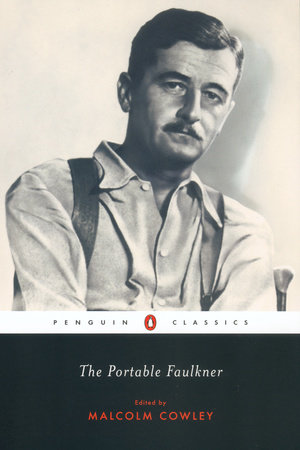
In prose of biblical grandeur and feverish intensity, William Faulkner reconstructed the history of the American South as a tragic legend of courage and cruelty, gallantry and greed, futile nobility and obscene crimes. He set this legend in a small, minutely realized parallel universe that he called Yoknapatawpha County, Mississippi.
No single volume better conveys the scope of Faulkner’s vision than The Portable Faulkner. The book includes self-contained episodes from the novels The Sound and the Fury, Light in August, and Sanctuary; the stories “The Bear,” “Spotted Horses,” “A Rose for Emily,” and “Old Man,” among others; a map of Yoknapatawpha County and a chronology of the Compson family created by Faulkner especially for this edition; and the complete text of Faulkner’s 1950 address upon receiving the Nobel Prize in literature. Malcolm Cowley’s critical introduction was praised as “splendid” by Faulkner himself.
For more than seventy years, Penguin has been the leading publisher of classic literature in the English-speaking world. With more than 1,800 titles, Penguin Classics represents a global bookshelf of the best works throughout history and across genres and disciplines. Readers trust the series to provide authoritative texts enhanced by introductions and notes by distinguished scholars and contemporary authors, as well as up-to-date translations by award-winning translators.
Author
William Faulkner
William Faulkner, one of the greatest writers of the twentieth century, was born in New Albany, Mississippi, on September 25, 1897. He published his first book, The Marble Faun, in 1924, but it is as a literary chronicler of life in the Deep South—particularly in the fictional Yoknapatawpha County, the setting for several of his novels—that he is most highly regarded. In such novels as The Sound and the Fury, As I Lay Dying, Light in August, and Absalom, Absalom! he explored the full range of post–Civil War Southern life, focusing both on the personal histories of his characters and on the moral uncertainties of an increasingly dissolute society. In combining the use of symbolism with a stream-of-consciousness technique, he created a new approach to fiction writing. In 1949 he was awarded the Nobel Prize for Literature. William Faulkner died in Byhalia, Mississippi, on July 6, 1962.
Learn More about William Faulkner