

Best Seller
Paperback
$18.00
Published on Mar 02, 2004 | 320 Pages

A New York Times Notable Book
Winner of the National Book Critics Circle Award for Criticism, The Mark Lynton History Prize, and the Sally Hacker Prize for the History of Technology
“A panoramic vision of cultural change” —The New York Times
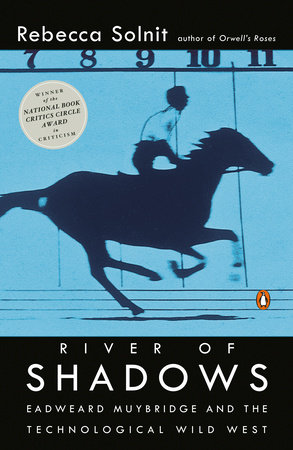
Through the story of the pioneering photographer Eadweard Muybridge, the author of Orwell’s Roses explores what it was about California in the late 19th-century that enabled it to become such a center of technological and cultural innovation
The world as we know it today began in California in the late 1800s, and Eadweard Muybridge had a lot to do with it. This striking assertion is at the heart of Rebecca Solnit’s new book, which weaves together biography, history, and fascinating insights into art and technology to create a boldly original portrait of America on the threshold of modernity. The story of Muybridge—who in 1872 succeeded in capturing high-speed motion photographically—becomes a lens for a larger story about the acceleration and industrialization of everyday life. Solnit shows how the peculiar freedoms and opportunities of post–Civil War California led directly to the two industries—Hollywood and Silicon Valley—that have most powerfully defined contemporary society.
Winner of the National Book Critics Circle Award for Criticism, The Mark Lynton History Prize, and the Sally Hacker Prize for the History of Technology
“A panoramic vision of cultural change” —The New York Times
Through the story of the pioneering photographer Eadweard Muybridge, the author of Orwell’s Roses explores what it was about California in the late 19th-century that enabled it to become such a center of technological and cultural innovation
The world as we know it today began in California in the late 1800s, and Eadweard Muybridge had a lot to do with it. This striking assertion is at the heart of Rebecca Solnit’s new book, which weaves together biography, history, and fascinating insights into art and technology to create a boldly original portrait of America on the threshold of modernity. The story of Muybridge—who in 1872 succeeded in capturing high-speed motion photographically—becomes a lens for a larger story about the acceleration and industrialization of everyday life. Solnit shows how the peculiar freedoms and opportunities of post–Civil War California led directly to the two industries—Hollywood and Silicon Valley—that have most powerfully defined contemporary society.
Author
Rebecca Solnit
Rebecca Solnit is the author of more than twenty books, including the memoir Recollections of My Nonexistence and the nonfiction A Field Guide to Getting Lost, The Faraway Nearby, A Paradise Built in Hell, River of Shadows, and Wanderlust. She is also the author of Men Explain Things to Me and many essays on feminism, activism and social change, hope, and the climate crisis. A product of the California public education system from kindergarten to graduate school, she is a regular contributor to The Guardian and other publications.
Learn More about Rebecca SolnitYou May Also Like
No-Man’s Lands
Paperback
$19.00
The Condor’s Shadow
Paperback
$23.00
J. M. Coetzee and the Life of Writing
Paperback
$17.00
Wanderlust
Paperback
$20.00
The Fish Can Sing
Paperback
$17.00
Tropical Classical
Paperback
$22.00
The Penguin Book of Spiritual Verse
Paperback
$19.00
Around the World in Seventy-Two Days and Other Writings
Paperback
$17.00
The Rush for Second Place
Paperback
$24.00
×