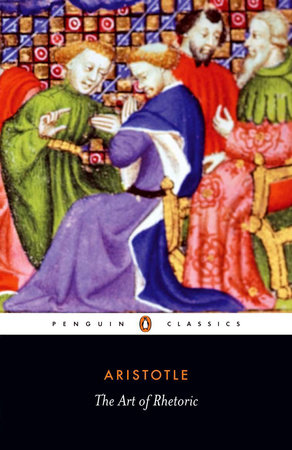
With the emergence of democracy in the city-state of Athens in the years around 460 BC, public speaking became an essential skill for politicians in the Assemblies and Councils—and even for ordinary citizens in the courts of law. In response, the technique of rhetoric rapidly developed, bringing virtuoso performances and a host of practical manuals for the layman. While many of these were little more than collections of debaters’ tricks, The Art of Rhetoric held a far deeper purpose. Here Aristotle establishes the methods of informal reasoning, provides the first aesthetic evaluation of prose style and offers detailed observations on character and the emotions.
Penguin Classics is the leading publisher of classic literature in the English-speaking world, representing a global bookshelf of the best works throughout history and across genres and disciplines. Readers trust the series to provide authoritative texts enhanced by introductions and notes by distinguished scholars and contemporary authors, as well as up-to-date translations by award-winning translators.
Author
Aristotle
Aristotle was born at Stageira, in the dominion of the kings of Macedonia, in 384 BCE. For 20 years he studied at Athens in the Academy of Plato, on whose death in 347 he left, and, sometime later, became tutor of the young Alexander the Great. When Alexander succeeded to the throne of Macedonia in 335, Aristotle returned to Athens and established his school and research institute, the Lyceum, to which his great erudition attracted a large number of scholars. After Alexander’s death in 323, anti-Macedonian feeling drove Aristotle out of Athens, and he fled to Chalcis in Euboea, where he died in 322. His writings, which were of extraordinary range, profoundly affected the whole course of ancient and medieval philosophy, and they are still eagerly studied and debated by philosophers today. Very many of them have survived and among the most famous are the Ethics and the Politics.
Learn More about Aristotle