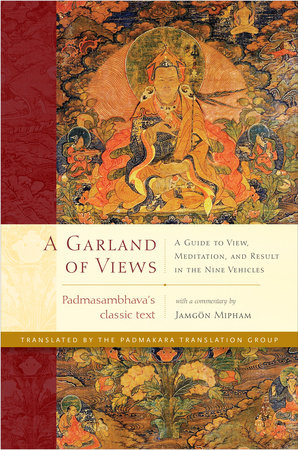
A core text of the Nyingma tradition of Tibetan Buddhism, presented in English for the first time, with commentary by Jamgön Mipham, one of the Nyingma tradition’s most lucid and brilliant minds.
A concise commentary by the eighth-century Indian Buddhist master Padmasambhava on a chapter from the Guhyagarbha Tantra, which gives an overview of the different Buddhist and non-Buddhist philosophical views, including the Great Perfection (Dzogchen), with an explicative commentary by the nineteenth-century scholar Jamgön Mipham (1846-1912). Padmasambhava’s text is a core text of the Nyingma tradition because it provides the basis for the system of nine vehicles (three sutra vehicles and six tantra vehicles) that subsequently became the accepted way of classifying the different Buddhist paths in the Nyingma tradition. Mipham’s commentary is the one most commonly used to explain Padmasambhava’s teaching. Mipham is well known for his prolific, lucid, and original writings on many subjects, including science, medicine, and philosophy, in addition to Tibetan Buddhist practice and theory.







 QUICK VIEW