

Best Seller
Loading
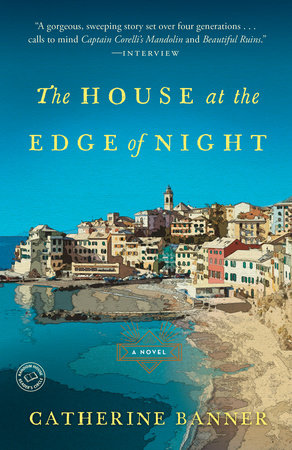
The House at the Edge of Night
Paperback
$19.00
Published on Jun 20, 2017 | 448 Pages



Author
Catherine Banner
Growing up I always loved stories and writing. When I was little one of my favourite games was to staple together sheets of paper and make them into a book with stories and pictures, and later I spent hours after school writing stories. One of the first books that captured my imagination was The Lion, the Witch and the Wardrobe by C. S. Lewis–I felt like I could believe in the story even though it was extraordinary and magical. But I think the book I most admired when I was growing up was To Kill a Mockingbird. Reading writing at its best and most honest was one of the things that most inspired me to want to write myself. I think The Eyes of a King really began with the voice of the narrator, Leo. It came to me so clearly that I wanted to write it down and try and capture that voice somehow. Most of the other characters and settings emerged from that. People have asked me why I wrote a story set in an alternative world. I think all writers are describing parallel worlds in a way because writing is often about how to find a new way of seeing things, so you can turn something familiar into another country and then people can see it again as if it’s for the first time. Although a lot of the ideas and characters for The Eyes of a King came to me easily, the challenge is always to find the most honest way of putting them into words. I think that will always be my main challenge, and what is at the heart of writing for me. I was at school when I was working on The Eyes of a King, so I wrote in any available time I had–sometimes I was even noting down a few sentences at the back of the class or in between lessons so as not to forget them. I think that was a good way to learn to write; it means everything you put down on paper has to be thought out first. Even now, I make up a lot of the story without putting pen to paper, and I can usually see the characters clearly before I write anything down. I left school last summer, and have spent the last year as a full-time writer, finishing off the second book in the trilogy and starting on the third. I don’t work to a set routine–I write best late at night and redraft best in the mornings so it depends what stage a story is at. I’m hoping to go to university in September, so I will have a different routine again for finishing off the final book in the trilogy. I started The Eyes of a King just after I turned 14. It was sometimes a challenge to balance writing with my other commitments, but I don’t think you are ever too young to start writing if you have a story you want to tell. I haven’t been a writer for that long, and I’m still learning all the time. But the most important thing that I try to do is to write about characters that I really care about, and leave out anything that doesn’t come from the heart.
Learn More about Catherine Banner QUICK VIEW
 QUICK VIEW
 QUICK VIEW
 QUICK VIEW
 QUICK VIEW
 QUICK VIEW
 QUICK VIEW
 QUICK VIEW
 QUICK VIEW
 QUICK VIEW