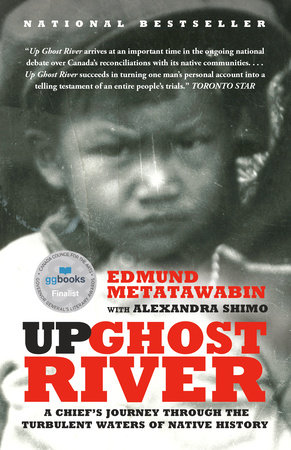
NATIONAL BESTSELLER
Finalist for the Governor General’s Literary Award for Non-Fiction
Winner of the CBC Bookie Award for Canadian Non-Fiction
A CBC Best Book of the Year
A Hill Times Best Book of the Year
A Quill & Quire Book of the Year
“Edmund Metatawabin’s voice is clear, brave and full of the grace of his Cree homeland. Up Ghost River is a powerful and unsettling read, full of heartbreaking truth-telling, resistance and Metatawabin’s uncompromising love of land, his people, his language and his culture. These stories are full of the real lived violence of colonialism and of the beautiful tiny moments that our Elders and storytellers wrap around our children to teach them, protect them and nurture them. Metatawabin is a gift to all who are lucky enough to read him, and the key to reading Metatawabin is a willingness to simply allow these stories to transform you.”
—Leanne Betasamosake Simpson, author of Noopiming
“A shocking, sadly revealing Canadian story. Cree elder Edmund Metatawabin has the courage to tell how ‘white learning’ stripped him of his name and systematically brutalized him—including strapping him into a school-built electric chair and electrocuting him—traumatizing him throughout his childhood, youth and adulthood, until he could finally let it all ‘pass through’ him and find himself as a human being. ‘We are still here,’ he asserts, and ‘our forefathers . . . are still here, all around us, guiding those who listen.’ Every Canadian needs to hear this story.” —Rudy Wiebe, author of The Temptations of Big Bear
“Thanks to the efforts of survivors like Edmund the federal government can no longer hide the shocking truth behind this terrible chapter in history, and survivors of St. Anne’s and other residential schools may finally receive the justice they rightly deserve. Edmund’s effort to document this abuse is as courageous as his dedication to healing himself and others from their experiences.”
—Nishnawbe Aski Nation (NAN) Deputy Grand Chief Alvin Fiddler, NationTalk
“With unsparing honesty, humility and disarming humour, Edmund Metatawabin reveals the darkness at the heart of Canadian history. A painful yet engaging narrative of personal trauma and recovery, this inspiring book also heralds the cultural and spiritual redemption of a people.”
—Gabor Maté, M.D., author of In the Realm of Hungry Ghosts: Close Encounters with Addiction
“A harrowing and redemptive story of a man’s personal battles with one of Canada’s worst practices. Edmund Metatawabin’s tale of residential schools and government bureaucracy will leave you angry at the evils of colonization. Yet it will also show you a man’s—and a people’s—incredible ability to survive and seek justice. There are plenty of ghosts in this book, apportions
of shame and responsibility, but Metatawabin’s journey and destination on that river will definitely leave you full of hope and richer for it.”
—Drew Hayden Taylor, author of Motorcycles & Sweetgrass
“Moving documentation, recollected tragedy and personal triumph, this book is a necessary first-hand account of being First Nations in contemporary Canada. From the atrocities of residential schools, to the present-day policy challenges, Up Ghost River will open your eyes to the all-too-recent history of Canada’s First Peoples, through the experiences of a resilient individual and his family.”
—The Right Honourable Paul Martin, former Prime Minister of Canada
“Up Ghost River is a very difficult story to read, but a necessary one in the reckoning of Canada’s abusive and exploitative relationship with its First Nations people. Edmund Metatawabin’s measured and honest account shows evidence of remarkable healing, and his story has much in common with the history of colonized Indigenous people around the world. . . . With Alexandra Shimo, Metatawabin writes about his life in a way that is both agonizing and redemptive, personal and political, gut-wrenching and level-headed; it will break your heart.”
—Christine Pountney, author of Sweet Jesus
“The word ‘courageous’ is often tossed around without much thought, but in the case of Edmund Metatawabin’s residential school memoir, the label fits. . . . While the book’s early chapters unearth horrific memories, Up Ghost River unfolds into an activist’s triumphant story of survival and resistance.”
—Quill & Quire (Book of the Year)
“The horror of Metatawabin’s account seem almost unbelievable, but it is all too factual, backed up with official documents. Nor can Canadians dismiss this as a tragedy from a now bygone era; Metatawabin argues that recent legislation from the Stephen Harper government is a continuation of oppression. This work is a harrowing but enthralling account of an aspect of Canadian history that the country would prefer to forget but which continues to haunt.”
—Publishers Weekly (starred review)
“The story of surviving the horrors of the residential school experience has been told by so many others. But Edmund Metatawabin’s Up Ghost River is told with such unsettling bravery, in plain, honest language, that this intimate portrait of his childhood resonates longer after the pages are closed.”
—Literary Review of Canada
“Up Ghost River arrives at an important time in the ongoing national debate over Canada’s reconciliations with its native communities, adding personal perspective and emotional texture to a debate far too many of us get to see only through an ideological lens. . . . A book that has the potential to be a valuable cultural document. . . . Up Ghost River succeeds in turning one man’s personal account into a telling testament of an entire people’s trials.”
—Toronto Star
“A searing memoir about a young boy and the legacy of trauma inflicted on Canada’s First Peoples by the residential school system. A gripping read.”
—The Globe and Mail
“This aptly titled, well-crafted book is an especially poignant reminder of the harm [residential schools] caused. . . . By weaving together memoirs and Indigenous cultural practices, the case that [Metatawabin] makes for a louder voice in the country’s political, economic and environmental decisions is cleverly strengthened.”
—Winnipeg Free Press
“Shocking, detailed and revealing. It is a story of profound courage, suffering, and an ongoing healing process. Despite the often dark and serious concepts discussed, a surprising humour is present as well. Read this book!”
—The Argus
“A searing memoir about a young boy and the legacy of trauma inflicted on Canada’s First Peoples by the residential school system. A gripping read.”
—Karyn L. Freedman, author of One Hour in Paris: A True Story of Rape and Recovery, quoted in the Globe and Mail
“A harrowing personal tale about brutality and healing.”
—Calgary Herald