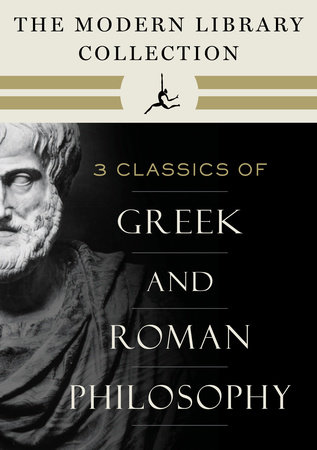
In the long history of philosophy and literature, few have been so widely read and admired as the great thinkers of Greece and Rome. For modern audiences, this eBook bundle—which collects the Modern Library editions of three classics: Marcus Aurelius’ Meditations, Selected Dialogues of Plato, and The Basic Works of Aristotle—is the perfect introduction to the foundation of modern knowledge. Accompanied by insightful, accessible commentary from some of today’s top scholars, including Gregory Hays, Hayden Pelliccia, and C.D.C. Reeve, this is a collection of ideas that changed the world—and have truly stood the test of time.
MEDITATIONS
Marcus Aurelius succeeded his adoptive father as emperor of Rome in A.D. 161—and Meditations remains one of the greatest works of spiritual and ethical reflection ever written. The Meditations have become required reading for statesmen and philosophers alike, while generations of readers have responded to the straightforward intimacy of the leader’s style. In Gregory Hays’s seminal translation, Marcus’s thoughts speak with a new immediacy: Never before have they been so directly and powerfully presented.
SELECTED DIALOGUES OF PLATO
In this volume, Hayden Pelliccia has revised five of Benjamin Jowett’s translations of Plato—classics in their own right—to produce a fresh, modern take that Library Journal calls “a needed and welcome addition to the translations of the Dialogues.” Here are Ion, Protagoras, Phaedrus, and the famous Symposium, which discuss poetry, the Socratic method, rhetoric, psychology, and love. Most dramatically, Apology puts Socrates’ art of persuasion to the ultimate test—defending his own life.
THE BASIC WORKS OF ARISTOTLE
Preserved by Arabic mathematicians and canonized by Christian scholars, Aristotle’s works have shaped Western thought, science, and religion for nearly two thousand years—and Richard McKeon’s edition has long been considered the best available one-volume Aristotle. Here are selections from the Organon, On the Heavens, The Short Physical Treatises, Rhetoric, among others, and On the Soul, On Generation and Corruption, Physics, Metaphysics, Nicomachean Ethics, Politics, and Poetics in their entirety.







 QUICK VIEW