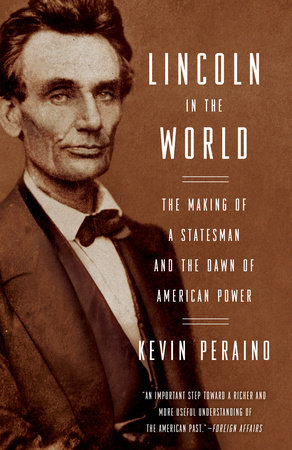
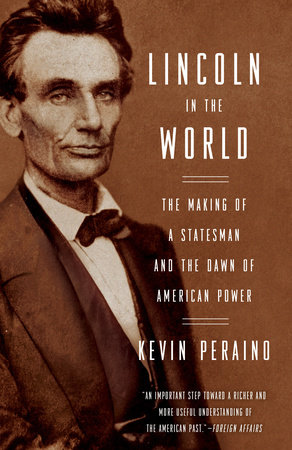
A Conversation with Kevin Peraino, author of LINCOLN IN THE WORLD:
The Making of a Statesman and the Dawn of American Power
________________________________________________________________________
Q) As a veteran foreign correspondent who has reported from throughout the world
(Libya, Yemen, Syria, Lebanon, Sudan, Egypt) you’ve long been fascinated by foreign affairs, witnessing it at the street level. How did this experience prime you to pen your book, Lincoln in the World?
A) In the news business it’s easy to find yourself fixated on the diplomatic donnybrook of the week. With this project I wanted to step back a little and take a macro approach—to try to make sense of what I had seen by looking at global affairs through the lens of some long-standing traditions of American foreign policy. The diplomacy of the Civil War caught my attention right away. It was clearly an overlooked story that was bursting with colorful personalities and important lessons for our own times.
Q) You went to college in Illinois (Northwestern University), the Land of Lincoln. Did that in some way encourage the writing of Lincoln in the World? Were you inspired by any other books, articles, or movies about Lincoln?
A) Absolutely. In the Chicago area, the streets are named after Sherman and Sheridan, the parks after Grant and Lincoln. I bought my first tattered copy of Carl Sandburg’s classic biography at a used bookshop on the North Shore while I was working as a cub reporter in Newsweek’s Chicago bureau just out of school.
Q) What sets Lincoln in the World apart from other books on the Great Emancipator?
A) There are thousands of books about Lincoln—but virtually none about his foreign policy. There hasn’t been a holistic, human account of Lincoln’s role in foreign affairs in nearly seventy years. Part of the problem is that Lincoln had a powerful and competent secretary of state in William Henry Seward. So books that put Lincoln at the center of his own foreign policy tend to end up as hagiographies. To solve that problem, I included only those episodes in which Lincoln was deeply involved—tightly focusing the narrative around five distinct conflicts that helped define the character of a Lincolnian foreign policy.
Q) When did you discover that this piece of Lincoln history was largely untold?
A) Almost right away. A great author once told me that the best books to write are the ones you want to read. I found myself strongly drawn to this overlooked aspect of Lincoln’s life, and I wanted to learn more. But there was very little out there.
Q) Jon Meacham, James McPherson, Amanda Foreman, and Michael Burlingame are among the handful of heavy hitters who have praised Lincoln in the World, calling it “engaging,” “penetrating,” “riveting,” and “elegantly written.” With such a welcome early reception, did you have any concerns adding to the existing Lincoln literature?
A) Yes! My friends teased me about it: What could I possibly add to the record about one of the world’s most written-about figures? But what astonished me as I was researching this was just how much fascinating new material about Lincoln has recently come to light. Scholars like Burlingame have dug deeply into the archival material in recent years—combing through not just the traditional letters and diaries, but also the archived papers of past historians and biographers, looking for information that has ended up on the cutting room floor. I took a similar approach—traveling from Springfield to London to Lexington in search of fresh material.
Q) Lincoln isn’t generally remembered as a great foreign-policy president, but in your book you argue that he was one of America’s indispensable diplomats—and a key architect of America’s emergence as a global superpower. Tell us about that.
A) It’s all in the way you look at it. James Randall, the great Lincoln biographer, once observed that compared to Teddy Roosevelt, or Woodrow Wilson, or Franklin Roosevelt, Lincoln’s involvement in international relations was minimal. That’s true enough—and makes perfect sense, since there was a devastating war raging on American soil. But Randall also rightly saw that the things Lincoln did do on the global stage were hugely important. So my approach was to home in on those critical foreign-policy decisions and really explore them in detail. As a result, we see Lincoln in a different light.
Q) Did you come across any interesting facts or details about Lincoln in your research that you think readers would be surprised to learn?
A) I was struck by Mary Lincoln’s attempts to influence diplomatic appointments. She was far more cosmopolitan than her husband. As a girl she had attended a school where students spoke French, run by Parisian aristocrats. Her parents were friends with some of the country’s great diplomats, and her childhood home was filled with Belgian rugs and French mahogany furniture. She certainly felt—with some justification—that she was more knowledgeable about the world than her husband. And she let him know it. On several occasions she urged him to appoint her candidates as foreign envoys, and she repeatedly tangled with Lincoln’s chief diplomat, Seward.
Q) There are many fascinating individuals who were involved in Lincoln’s foreign policy legacy and who you highlight in Lincoln in the World. Who did you find most interesting to research?
A) The French emperor, Napoleon III, was a particularly intriguing character. He was a poor strategist and a serial womanizer—deeply insecure and usually inscrutable. Otto von Bismarck described him as “a great unfathomed capacity.” Even his youthful girlfriends found him difficult to read. One marriage prospect later said that Napoleon was so opaque that she worried she would have “broken his head open just to see what was in it.” Lincoln, too, found himself wondering what Napoleon was thinking when the French emperor invaded Mexico during the height of the Civil War.
Q) What do you think are some of the important takeaways of Lincoln’s foreign policy for the present day? How do you think the foreign policy of President Obama is similar or different to President Lincoln’s?
A) In one sense, there’s no comparison—the U.S. was essentially an emerging market in the Civil War era; now it’s the most powerful nation on the planet. But there are some intriguing similarities in the times. The mid-nineteenth century was an information age. The newspaper culture of the Civil War era is not so different from our own world of burgeoning new media. Yet it was also a period of brutal realism, an age that resembles in significant ways our own increasingly multipolar world.
Q) The Lincoln who you portray in your book is in many ways a different man than we think we know. Which aspect of his character most surprised you?
A) I was genuinely surprised by the scope of his worldview. We learn in grade school that European politics played some role in his decision to issue the Emancipation Proclamation. But Lincoln was constantly thinking about America’s place in the world. His first political handbill, nearly thirty years before the outbreak of the Civil War, argued that local schools should teach students more about foreign cultures. His economic vision as a Whig coming up in Illinois politics was all about building roads and canals—important links to the outside world. By the time he took office, he was making the case that the “central idea” of the looming war was to prove “that popular government is not an absurdity.” We’ve all heard Lincoln’s famous lines about America as the world’s “last, best hope.” But there’s a lot more to the story.






 QUICK VIEW