

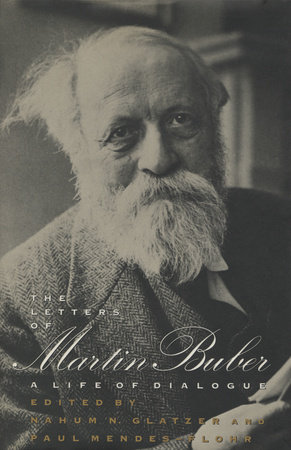

“No matter how brilliant it may be, the human intellect that wishes to keep to a plane above the events of the day is not really alive,” wrote Martin Buber in 1932. The correspondence of Martin Buber reveals a personality passionately involved in all the cultural and political events of his day.
Drawn from the three-volume German edition of his correspondence, this collection includes letters both to and from the leading personalities of his day—Albert Einstein and Albert Schweitzer, Hemann Hesse, Franz Kafka, and Stefan Zweig, Theodor Herzl, Chaim Weizmann, David Ben-Gurion, S.Y. Agnon, Gershom Scholem, and Franz Rosenzweig. These exchanges capture the dynamics of seven decades of lived history, reflected through the eyes of a man who was the conscience of his generation.
One of the leading spiritual thinkers of the twentieth century, Buber is best known for his work of religious existentialism, I and Thou. A prime mover in the German-Jewish renaissance of the 1920s, he taught comparative religion and Jewish ethics at the University of Frankfurt. Fleeing the Nazis in 1938, Buber made his home in Jerusalem, where he taught social philosophy at the Hebrew University. As resident sage of Jerusalem, he developed an international reputation and following, and carried on a vigorous correspondence on social, political, and religious issues until the end of his life.
Included in this collection are Buber’s exchanges with many Americans in the latter part of his life: Will Herberg, Walter Kaufmann, Maurice Friedman, Malcolm Diamond, and other individuals who sought his advice and guidance. In the voices of these letters, a full-blooded portrait emerges of a towering intellect ever striving to live up to philosophy of social engagement.
Author
Martin Buber
Martin Buber (1878–1965), one of the paramount spiritual leaders of the twentieth century, is best known as the author of I and Thou—the basic formulation of his philosophy of dialogue—and for his appreciation of Hasidim, which made a deep impact on Christian as well as Jewish thinkers. Born in Vienna, and raised in Lemberg, Buber studied philosophy at the University of Berlin. Fleeing Nazi Germany in 1938, he emigrated to Israel, where he taught social philosophy at the Hebrew University until his retirement in 1951. He lived in Jerusalem until his death in 1965.Also published by Schocken Books, Martin Buber’s work include: Israel and the World, The Legend of the Baal-Shem, The Letters Of Martin Buber, On the Bible, On Judaism, On Zion, Tales of the Hasidim, Ten Rungs, and Way of Response.
Learn More about Martin Buber