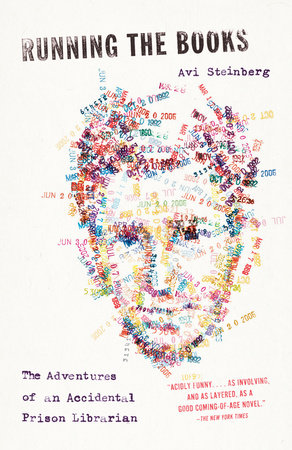
Your memoir Running the Books is the ultimate fish out of water story. How did you wind up in prison?
I ended up in prison the way most people end up there. By accident. It’s a classic tale, really. An Orthodox Jewish guy leaves the fold, goes to Harvard, gets bad grades, then becomes a freelance obituary writer, then gets punched in the face at an Orthodox wedding which makes him realize that he must get his life in order. That he needs healthcare. And so he sends out his resume to a prison in the hopes of achieving all that. Health care and order. As I said, a classic American tale. Now, why I went to work specifically in a prison and specifically in a prison library, that’s a slightly different story. In many ways it took, I think, working there for more than two years to discover what I was looking for to begin with. And I think that’s really the saga I describe in this book.
Aside from the obvious answer of clientele, how does a prison library differ from a general public library?
One major difference is that the people who visit a prison library also live together, in this estranged sort of way. They’re around each other nonstop, every day, all day. And the action that occurs in a prison library is always an extension of the drama that is happening upstairs in the cells, in the prison blocks, and to some extent from previous dramas on the street. Everybody’s implicated in everybody’s life. The library functions very differently in these dramas. Sometimes it’s a place for people to gain some privacy and to momentarily escape. But more often it’s a place for people to confront their issues head on. So in a funny way the prison library functions as much as a family living room as it does a shared public space.
One of the most moving threads in the narrative involves your attempt to orchestrate a reunion between an inmate and her estranged son. What’s the story there?
The prison where I worked held men and women, and these populations were kept separate at all times. They never ever came into contact. But the tension between the sexes was immense, a constant feature of the place. From up in the tower the women could look down into the prison yard and see the men, for example. And they left notes for each other hidden in the library books.
The story of Jessica and her son is a central strain in the book. She attended a creative writing class of mine held up in the tower for the sole reason of sitting by the classroom window and looking down at this 18-year-old recently arrived inmate, her son. The last time she saw him in person was roughly 16 years earlier when she abandoned him in a church, and now here they were, inmates in the same prison. At first she wanted to just look at him. Later she decided to connect with him. I wish I could say that this ended well, but it’s actually the beginning of a story that ended sadly.
As you continued to work at the prison you increasingly ran into ex-cons on the outside. What was that like?
Yeah, my adventures always began in prison, but often did not end there. This is actually pretty accurate if you work at a prison full-time long enough. The prison walls cease to be this barrier between the inside where you work and the outside where you live. People often asked me if I felt scared working in prison and there were some touchy moments, but the truth is that many of the charged encounters happened outside. An inmate who’s in his street clothes looks almost like a different person. I was actually mugged near my house by a former inmate and in the middle of the mugging this person actually recognized me.
In another scene you describe talking to an inmate who’s not only fascinated by Orthodox Jews but admiring of them. Did this surprise you?
Ah, yes. The man in question was an inmate in the prison library work detail. He was a young African-American convert to Islam who obviously didn’t get the memo that Jews and Muslims are not supposed to find common ground. But he actually saw a lot of similarities between them, all of which are very much there, I think. And as he struggled to embrace his new way of life, he turned to me, a former Orthodox Jew, for advice. It was a fascinating ongoing conversation.
Now what was hilarious is that he thought that Orthodox Jews were cool. This really surprised me. But he was serious. The black hats, the beards, he loved this stuff. It occurred to me that he regarded Orthodox Jews as a street gang with matching clothes and attitudes and complete loyalty to one another. This really made me think of myself and my own upbringing and I have to say, there were some connections.
What do you hope the reader will take away from your story?
I had this astronomy professor in college who started off his lectures by saying, “Imagine that the universe is this room.” He would say this in order to get our minds around the incomprehensibly vast distance of space. He was trying to get us to see the entire universe on a totally different scale. So sometimes in order to get a sense of scale we need to take this cockeyed view.
The US has the biggest prison system not just in the world but in the history of the world. It’s a situation on an enormous scale, very difficult to grasp. So what I tried to do in this book is bring the scale of prison down to a human level, to shrink it down to a room, just like my professor said, into what I think is the most dynamic and charged room in the prison. The library. By entering this human-scale sized space, I was able to put myself directly into relationship with it, and I learned a great deal about myself in the process. Where I fit it. And I wrote about this room, its life and its people, as I saw and experienced it. But I really want the reader to see this remarkable, hidden place for himself. To browse through the shelves and the secret corners. To watch, to listen. To find something for himself on his own.