

Best Seller
Ebook
Published on Sep 05, 2012 | 464 Pages

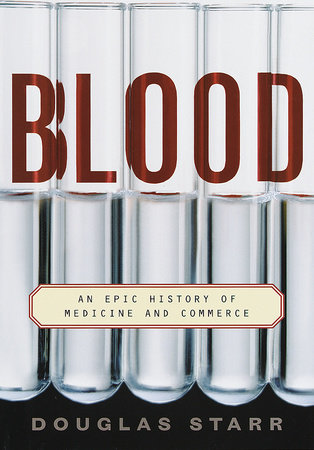
Essence and emblem of life–feared, revered, mythologized, and used in magic and medicine from earliest times–human blood is now the center of a huge, secretive, and often dangerous worldwide commerce. It is a commerce whose impact upon humanity rivals that of any other business–millions of lives have been saved by blood and its various derivatives, and tens of thousands of lives have been lost. Douglas Starr tells how this came to be, in a sweeping history that ranges through the centuries.
With the dawn of science, blood came to be seen as a component of human anatomy, capable of being isolated, studied, used. Starr describes the first documented transfusion: In the seventeenth century, one of Louis XIV’s court physicians transfers the blood of a calf into a madman to "cure" him. At the turn of the twentieth century a young researcher in Vienna identifies the basic blood groups, taking the first step toward successful transfusion. Then a New York doctor finds a way to stop blood from clotting, thereby making all transfusion possible.
In the 1930s, a Russian physician, in grisly improvisation, successfully uses cadaver blood to help living patients–and realizes that blood can be stored. The first blood bank is soon operating in Chicago.
During World War II, researchers, driven by battlefield needs, break down blood into usable components that are more easily stored and transported. This "fractionation" process–accomplished by a Harvard team–produces a host of pharmaceuticals, setting the stage for the global marketplace to come. Plasma, precisely because it can be made into long-lasting drugs, is shipped and traded for profit; today it is a $5 billion business.
The author recounts the tragic spread of AIDS through the distribution of contaminated blood products, and describes why and how related scandals have erupted around the world. Finally, he looks at the latest attempts to make artificial blood.
Douglas Starr has written a groundbreaking book that tackles a subject of universal and urgent importance and explores the perils and promises that lie ahead.
With the dawn of science, blood came to be seen as a component of human anatomy, capable of being isolated, studied, used. Starr describes the first documented transfusion: In the seventeenth century, one of Louis XIV’s court physicians transfers the blood of a calf into a madman to "cure" him. At the turn of the twentieth century a young researcher in Vienna identifies the basic blood groups, taking the first step toward successful transfusion. Then a New York doctor finds a way to stop blood from clotting, thereby making all transfusion possible.
In the 1930s, a Russian physician, in grisly improvisation, successfully uses cadaver blood to help living patients–and realizes that blood can be stored. The first blood bank is soon operating in Chicago.
During World War II, researchers, driven by battlefield needs, break down blood into usable components that are more easily stored and transported. This "fractionation" process–accomplished by a Harvard team–produces a host of pharmaceuticals, setting the stage for the global marketplace to come. Plasma, precisely because it can be made into long-lasting drugs, is shipped and traded for profit; today it is a $5 billion business.
The author recounts the tragic spread of AIDS through the distribution of contaminated blood products, and describes why and how related scandals have erupted around the world. Finally, he looks at the latest attempts to make artificial blood.
Douglas Starr has written a groundbreaking book that tackles a subject of universal and urgent importance and explores the perils and promises that lie ahead.
Author
Douglas Starr
Douglas Starr is codirector of the Center for Science and Medical Journalism and a professor of journalism at Boston University. His book Blood: An Epic History of Medicine and Commerce won the 1998 Los Angeles Times Book Prize and became a PBS-TV documentary special. A veteran science, medical, and environmental reporter, Starr has contributed to many national publications, including Smithsonian, Audubon, National Wildlife, Sports Illustrated, the Los Angeles Times, The Christian Science Monitor, and Time, and has served as a science editor for PBS-TV. He lives near Boston.
Learn More about Douglas StarrYou May Also Like
China’s Silent Army
Ebook
$9.99
The Killer of Little Shepherds
Paperback
$20.00
A Fragile Future
Ebook
$2.99
Ethical Realism
Paperback
$13.95
Asia’s Reckoning
Paperback
$18.00
The United States of Wal-Mart
Ebook
$5.99
Of a Fire on the Moon
Paperback
$22.00
Antarctica 2041
Ebook
$14.99
The Men Who Wear the Star
Ebook
$14.99
×