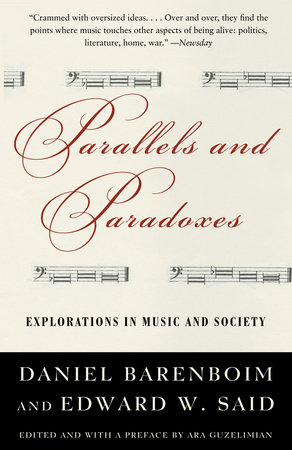
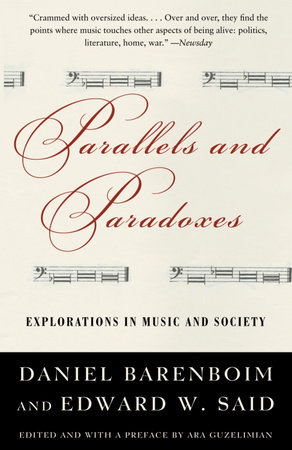
These free-wheeling, often exhilarating dialogues are an exchange between two prominent figures in contemporary culture: Daniel Barenboim, internationally renowned conductor and pianist, and Edward W. Said, eminent literary critic and impassioned commentator on the Middle East. Barenboim is an Argentinian-Israeli and Said a Palestinian-American; they are also close friends.
“[A] genuine give-and-take between keen minds and open hearts. . . . The fluidity of their relationship, like musicians in an orchestra, is a compelling model for a world often splintered by dogma, ideology and hermetically sealed minds.” –Los Angeles Times
As they range across music, literature, and society, they open up many fields of inquiry: the importance of a sense of place; music as a defiance of silence; the legacies of artists from Mozart and Beethoven to Dickens and Adorno; Wagner’s anti-Semitism; and the need for “artistic solutions” to the predicament of the Middle East—something they both witnessed when they brought young Arab and Israeli musicians together. Erudite, intimate, thoughtful and spontaneous, Parallels and Paradoxes is a virtuosic collaboration.






 QUICK VIEW