
Best Seller
Paperback
$22.00
Published on Jan 04, 2000 | 288 Pages

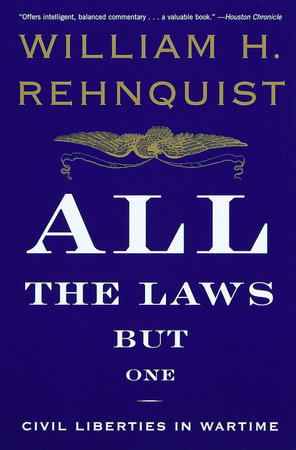
William H. Rehnquist, Chief Justice of the United States, provides an insightful and fascinating account of the history of civil liberties during wartime and illuminates the cases where presidents have suspended the law in the name of national security.
“A highly original account of the proper role of the Supreme Court, a role that makes most sense in times of war, but that has its attractions whenever the Court is embroiled in great social controversies.” —The New Republic
Abraham Lincoln, champion of freedom and the rights of man, suspended the writ of habeas corpus early in the Civil War–later in the war he also imposed limits upon freedom of speech and the press and demanded that political criminals be tried in military courts. During World War II, the government forced 100,000 U.S. residents of Japanese descent, including many citizens, into detainment camps. Through these and other incidents Chief Justice Rehnquist brilliantly probes the issues at stake in the balance between the national interest and personal freedoms. With All the Laws but One he significantly enlarges our understanding of how the Supreme Court has interpreted the Constitution during past periods of national crisis–and draws guidelines for how it should do so in the future.
“A highly original account of the proper role of the Supreme Court, a role that makes most sense in times of war, but that has its attractions whenever the Court is embroiled in great social controversies.” —The New Republic
Abraham Lincoln, champion of freedom and the rights of man, suspended the writ of habeas corpus early in the Civil War–later in the war he also imposed limits upon freedom of speech and the press and demanded that political criminals be tried in military courts. During World War II, the government forced 100,000 U.S. residents of Japanese descent, including many citizens, into detainment camps. Through these and other incidents Chief Justice Rehnquist brilliantly probes the issues at stake in the balance between the national interest and personal freedoms. With All the Laws but One he significantly enlarges our understanding of how the Supreme Court has interpreted the Constitution during past periods of national crisis–and draws guidelines for how it should do so in the future.
Author
William H. Rehnquist
William H. Rehnquist was born in Milwaukee, Wisconsin, and served in the U.S. Army Air Corps during World War II. He earned his B.A. and M.A. in political science from Stanford University and a second M.A. from Harvard. He graduated first in his class at Stanford Law School in 1952. In 1969 Rehnquist became assistant attorney general for the Justice Department’s Office of Legal Council. He was confirmed by the Senate as an associate justice of the Supreme Court in December 1971, and took his place on the bench in January 1972. He became the sixteenth Chief Justice of the Supreme Court in 1986. He lives in Arlington, Virginia.
Learn More about William H. RehnquistYou May Also Like
Leading the Way
Ebook
$14.99
The Vast Left Wing Conspiracy
Ebook
$4.99
The Last Best Hope
Ebook
$4.99
Island of Blood
Paperback
$19.00
How Wars Are Won
Paperback
$21.00
My Nuclear Family
Ebook
$14.99
The Supreme Court
Paperback
$22.00
What It Means to Be a Libertarian
Paperback
$18.00
Once Upon a Distant War
Paperback
$22.00
×